
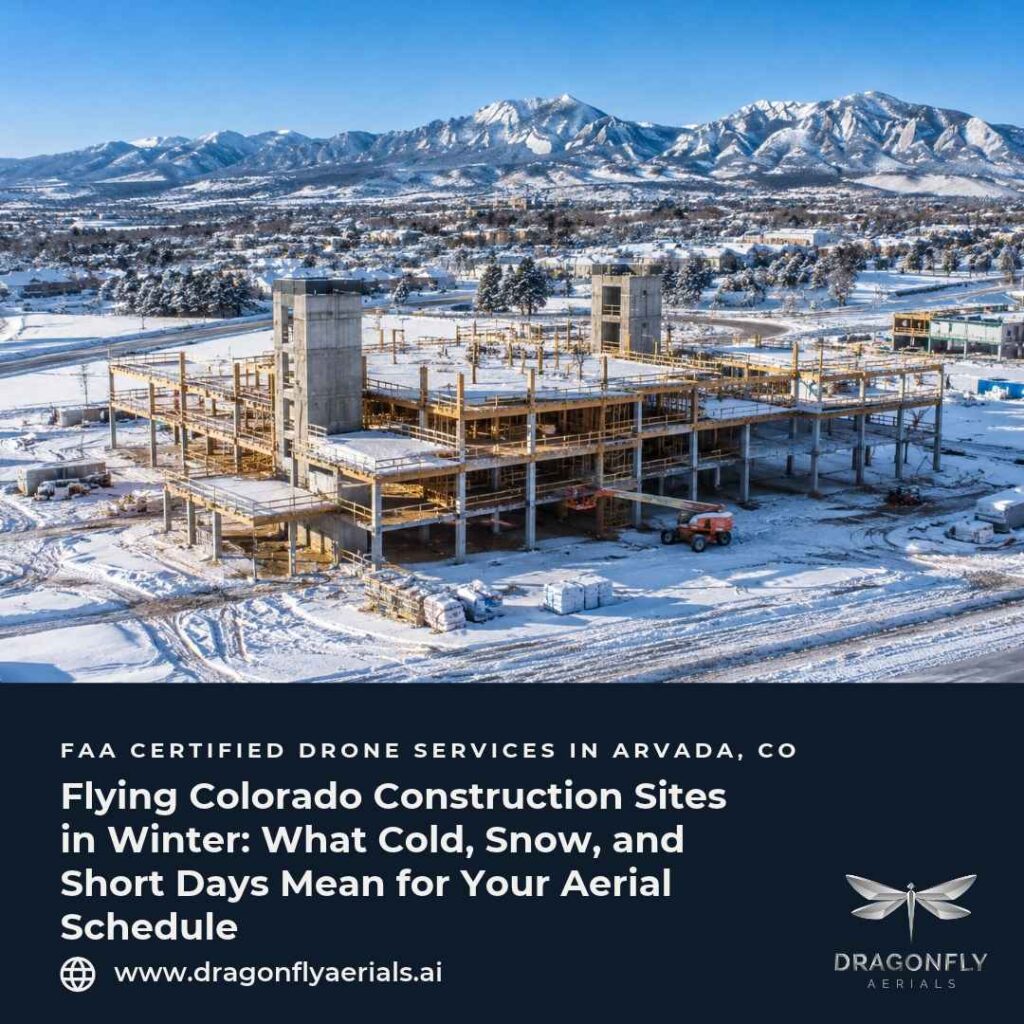
The owner’s representative sends a short email in the second week of December: the building is dried in on the north side, the parking lot is still dirt, and the lender’s inspector wants current photos for the draw. The last flight was three weeks ago. Since then, the site has seen a hard freeze, a storm, and a stretch of days that were too short and too windy to put an aircraft up. Nobody planned for a gap, but there is one.
Winter does not stop most Front Range projects, but it does change how aerial documentation gets scheduled. This article walks through the practical limits that apply to winter flights in Colorado, and how to build a schedule that still produces current records when you need them.
What actually limits a winter flight
Cold temperature gets the attention, but it is only one of several constraints. Pilots operating under Part 107 are bound by weather minimums regardless of season. Under 14 CFR 107.51, visibility from the control station must be no less than 3 statute miles, and the aircraft must stay at least 500 feet below clouds and 2,000 feet horizontally from them. Falling snow, low ceilings, and blowing snow near the ground can all push a day below those minimums even when the air temperature is workable.
The pilot also has a duty to assess the operating environment before every flight. 14 CFR 107.49 lists local weather conditions among the items a remote pilot must consider in the preflight assessment. In practice, that means a flight can be scheduled for Tuesday and still be called off Tuesday morning. A good provider will tell you that up front instead of promising a fixed date.
Temperature and batteries
Aircraft manufacturers publish operating temperature ranges, and they vary by model. As one example, a published specification sheet for a widely used enterprise aircraft, the DJI Matrice 350 RTK, lists an operating range of -20 to 50 degrees Celsius (-4 to 122 degrees Fahrenheit), with a narrower range for charging. That is one aircraft; the point for a project team is that every platform has a range, and a pilot who respects it will sometimes wait for the afternoon to warm up. Cold also tends to shorten usable flight time, which can mean more battery swaps on a large site.
Wind, light, and short days
Front Range winter days are often clear and dry, which suits aerial work, but they are also short, and low sun angles throw long shadows across a site. Long shadows can hide detail along north faces and in excavations. For documentation flights, the practical answer is to fly in the middle of the day when the shadows are shortest, and to keep the capture time consistent from visit to visit so the images compare cleanly.
What Colorado winter looks like on paper
Snow is not a surprise on the Front Range, but how much falls and when varies year to year. Reporting by Denver7 on National Weather Service records over 129 years puts the average snowfall in Denver at 4.1 inches in October and 7.4 inches in November. The same article noted that the 2021 season’s first measurable snow did not arrive until December, a record for the latest first snow. The takeaway for scheduling is that averages describe a range, not a calendar. A site manager should plan around the possibility of weather windows closing for several days, not around the average.
Building a winter capture schedule
Three habits keep winter records useful without relying on perfect weather.
Schedule a window, not a day
Instead of booking a single date, agree on a capture window of several days. If Tuesday is too windy, Wednesday or Thursday takes its place. This is the same approach most superintendents already use for concrete pours and roofing.
Back-time the flight from the draw date
On many projects, pay applications are assembled on or around the 20th of the month, with completed work projected or prorated through month-end. That is a common pattern, not a universal rule, and requirements vary by loan agreement and project. Where it applies, it means the aerial images that support the draw need to be fresh when the package comes together. If the draw package goes together on the 20th and a winter window can close for several days, flying earlier in the month leaves room to re-fly. Deliverables are normally returned within 2–3 business days of the flight, so the capture window should close well before the date the package is due.
Keep the framing consistent
Records that are captured from the same positions at the same time of day are easier to compare. Snow cover complicates this. A site under a few inches of snow looks different from the week before, and some conditions, such as exact ground surface elevations, are harder to read through snow. That is a reason to capture a clean, snow-free record before the first significant storm, and then to document winter conditions as what they are: a dated record of how the site was left, which areas were protected, and what was and was not accessible.
What winter documentation is good for
A winter record answers questions that otherwise turn into arguments in spring. Was the stockpile covered when the storm arrived? Was the temporary access road intact? Were the perimeter controls still in place after the freeze-thaw cycle? Dated images do not settle every question, and they do not replace a field inspection or an engineer’s judgment, but they give the project team a shared starting point. Our construction progress documentation work is built around recurring flights with consistent capture, and our orthomosaic mapping and 3D modeling service can add measurable site maps when a project needs them. Neither is a substitute for the surveying deliverables that licensed surveyors provide.
Questions to ask your drone provider before winter
A short list helps set expectations before the first cold snap arrives:
- How do you schedule capture windows when weather closes a planned flight?
- What is your usual turnaround after a flight?
- Can the flights be timed ahead of our draw or reporting dates?
- How do you keep capture positions consistent from visit to visit?
If you want to see how a recurring winter schedule would work on your project, our How It Works page covers the process, and you can browse all services for the other options.
Plan your winter flights now
If a project of yours will keep moving through the cold months, it is easier to set the schedule in November than to scramble in December. Get a quote, and we will talk through your site, your reporting dates, and a capture window that fits.
Sources
- 14 CFR 107.51, Operating limitations for small unmanned aircraft (Cornell Legal Information Institute)
- 14 CFR 107.49, Preflight familiarization, inspection, and actions for aircraft operation
- Denver7, Denver’s first snow of the season likely won’t arrive until December, NWS says (November 22, 2021)
- DJI Matrice 350 RTK specifications (DroneDesk)